
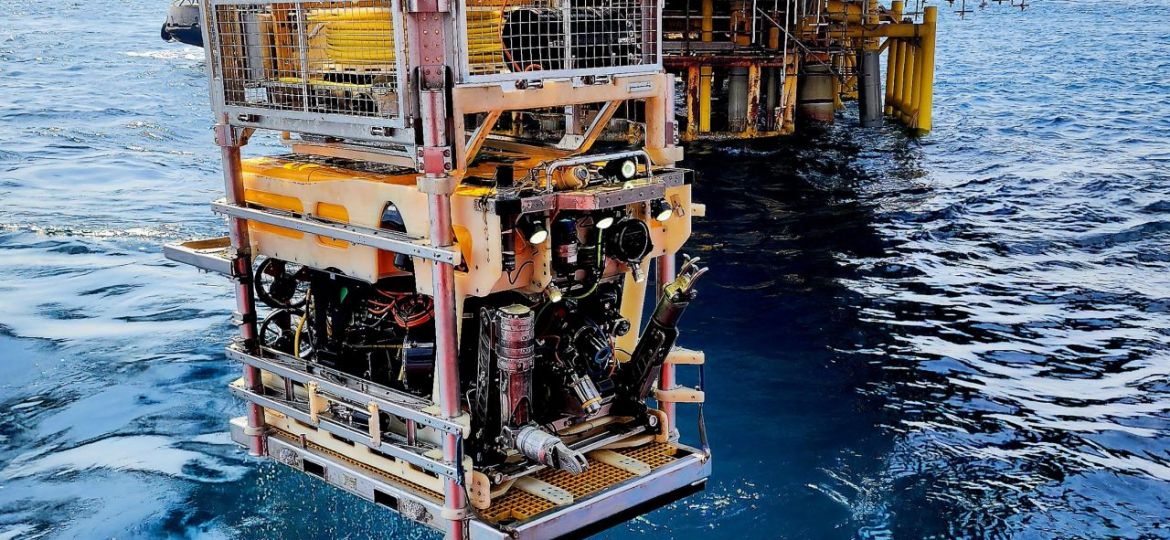
SEEING UNDERWATER: A FAR MORE COMPLEX CHALLENGE THAN IT SEEMS
Whether for infrastructure inspection, scientific exploration, or industrial operations, underwater vision is a key success factor. Yet integrating a high-performance underwater camera onto an ROV, AUV, or diver system remains a real technical challenge.
Contrary to popular belief, it is not enough to simply “mount a camera” to obtain usable images. In underwater environments, every constraint (optical, mechanical, electronic, human) accumulates. Many conditions must be met to enable safe and efficient operations.
GENERAL CONSTRAINTS OF THE UNDERWATER ENVIRONMENT
Natural Visibility Degradation
Water absorbs light, diffuses colors, and carries suspended particles. Within the first few meters, contrast drops, colors fade, and visual noise increases. This degradation becomes even more severe in turbid environments (ports, dams, industrial areas).
Direct consequence: a sensor that performs perfectly in air can become unusable underwater if it is not specifically designed for these conditions.
Lighting: An Essential Ally… and a Common Pitfall
Lighting is inseparable from the camera. Poorly controlled lighting can actually worsen visibility by creating backscatter effects, where illuminated particles become more visible than the scene itself.
Integrating a camera without carefully considering lighting angle, power, and beam pattern is one of the most common mistakes.
Pressure, Corrosion, and Mechanical Constraints
Beyond optical challenges, strong physical constraints must also be addressed:
-
Increasing hydrostatic pressure with depth
-
Corrosion caused by saltwater
-
Galvanic corrosion resulting from direct contact between dissimilar materials in a saline environment
-
Shocks, vibrations, and repeated handling
The housing, connectors, and optics must be designed as a robust, integrated system, not as a simple waterproof enclosure.
COMMON CHALLENGES WHEN INTEGRATING INTO EXISTING SYSTEMS
Mechanical Interfaces and Space Constraints
Each platform has its own volume, weight, and mounting limitations. A camera that is too heavy or poorly balanced can affect the stability of an ROV or the ergonomics of a diver’s equipment.
Mechanical integration is often underestimated, yet it directly impacts image quality and operational safety.
Video Data and System Compatibility
Ethernet, fiber, coaxial, compressed or raw formats: the camera must integrate into an existing video chain.
Protocol or format incompatibility can lead to latency, data loss, or image degradation, even with an excellent sensor.
SPECIFIC CHALLENGES FOR ROV INTEGRATION
ROVs offer a degree of flexibility but come with their own constraints:
-
Multiple onboard sensors
-
Electromagnetic interference
-
Requirement for reliable real-time vision for piloting
-
Mechanical and electrical grounding isolation
The camera becomes a critical operational tool whose reliability directly impacts mission safety and efficiency.
SPECIFIC CHALLENGES FOR AUV INTEGRATION
On an AUV, every gram and every watt matters. The camera must operate autonomously, often without direct human supervision.
Key challenges include:
-
Size optimization
-
Extreme power consumption optimization
-
Software robustness
-
Ability to produce usable images without real-time adjustment
Here, onboard image processing becomes crucial.
SPECIFIC CHALLENGES FOR DIVER INTEGRATION
For a diver, the camera is primarily a decision-support tool.
Constraints are different:
-
Ergonomics and ease of use
-
Immediate image readability
-
Absolute reliability in sometimes degraded conditions
An unclear or unstable image can slow down operations—or even increase risks.
THINKING OF INTEGRATION AS A SYSTEM, NOT AN ACCESSORY
Integrating an underwater camera is never just about selecting a sensor. It requires a global vision of the system, the environment, and the final use case.
This is the approach taken by the engineers behind Orphie Camera. Delivering the best image quality and visibility meant going beyond pure performance and fully addressing integration within existing systems. That is why Orphie cameras are easily integrated onto inspection and work-class ROVs, AUVs, and diver systems.
For every environmental constraint, the Orphie camera has been specifically designed and developed to respond:
-
Galvanic corrosion: Electrical and physical isolation of materials with high galvanic potential differences.
-
Standard corrosion: Hard anodized aluminum housing.
-
ROV network integration: Users can configure network parameters according to their needs (IP, bandwidth, gateway, subnet).
-
Ground loop issues: Isolation between electronic and mechanical grounds.
-
Hydrostatic pressure: Pressure resistance tested with a safety factor of 3 in design and 1.5 in production, applied to 100% of products.
-
Lighting integration: Dedicated integration guidance to optimize image quality.
By addressing these critical integration challenges, Orphie cameras stand out as the preferred choice for system integrators. They deliver safety, productivity gains, and financial savings for inspection companies, while remaining easily integrable across all types of underwater inspection platforms.