
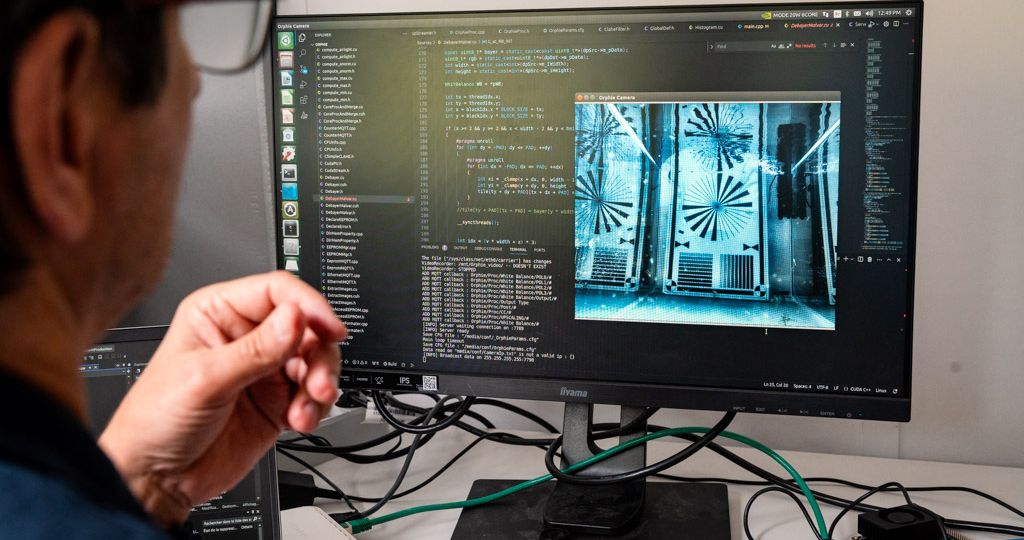
The underwater inspection industry is rapidly evolving thanks to new technologies. Between the rise of underwater drones, improvements in vision systems, and increasing automation of operations, artificial intelligence (AI) is gradually becoming a central topic within the sector.
Whether for dam inspections, ship hull surveys, offshore structures, or port infrastructure assessments, professionals are constantly looking for ways to save time, improve analysis accuracy, and reduce operational costs. In this context, AI appears to be a promising solution. However, its use also raises major questions, particularly regarding image reliability and trust in the data being analyzed.
WHY IS AI ATTRACTING ATTENTION IN THE UNDERWATER INSPECTION INDUSTRY?
The underwater environment remains particularly challenging for operators. Poor visibility, turbidity, low-light conditions, suspended particles, and depth constraints make inspections difficult to perform and interpret while still requiring extremely precise measurements.
AI can assist field teams and analysts at several levels.
1. SUPPORTING AUTONOMOUS NAVIGATION
Artificial intelligence is playing an increasingly important role in the development of autonomous AUVs and ROVs. Through various real-time analysis systems, some vehicles can automatically maintain their trajectory, avoid obstacles, follow structures, or optimize inspection routes.
In the long term, these technologies could help reduce pilots’ cognitive workload, improve the safety of complex operations, and accelerate repetitive missions, particularly during lengthy inspections or in challenging environments.
2. IMAGE ENHANCEMENT
Image enhancement is probably the most visible AI application currently used in the underwater industry. Some algorithms can reduce digital noise, artificially increase contrast, improve sharpness, or even recolor certain areas to make scenes easier to interpret.
In highly turbid environments, these processes can produce impressive results at first glance. Some technologies even go as far as “reconstructing” supposedly invisible details to generate visually clearer images.
However, this approach raises significant concerns within the inspection sector, where the reliability and fidelity of visual information are critical.
3. AUTOMATING VIDEO ANALYSIS
AI is also being used to optimize the analysis of video data collected during underwater missions. Some solutions can automatically sort relevant sequences, stabilize footage, track structures or objects throughout an inspection, and even generate preliminary reports based on detected anomalies.
In an industry where visual data volumes continue to grow, these tools offer the potential to reduce post-mission processing time and improve the overall exploitation of inspection data.
4. ASSISTING WITH DEFECT DETECTION
One of the earliest applications of AI in underwater inspection involves anomaly detection. Today, algorithms can be trained to automatically identify recurring defects such as cracks, corrosion, welding flaws, biofouling, impacts, deformations, or material loss.
The objective is not necessarily to replace human expertise but rather to assist operators in reviewing long hours of inspection footage. By automatically drawing attention to potentially critical areas, these tools can save time and facilitate interpretation.
THE POTENTIAL BENEFITS OF AI
The integration of artificial intelligence offers several advantages for industry stakeholders.
First, AI can significantly reduce the time required for inspections, particularly during post-processing activities. Automated analysis of large volumes of video data can substantially accelerate both inspection workflows and reporting phases.
Indeed, underwater missions generate enormous amounts of visual content. Intelligent tools help organize, search, and compare this data more efficiently over time.
Within this content, AI can also serve as an assistant by highlighting suspicious areas that operators may not have immediately identified.
By optimizing inspection and analysis times, some companies hope to reduce operational costs and limit the number of interventions required.
BUT AI ALSO RAISES MAJOR CONCERNS
Despite its promises, the use of AI in underwater inspection remains a sensitive topic. The primary issue concerns the reliability of the information displayed on screen, particularly visual feedback.
The Creation of Non-Existent Information
One of the key risks is the creation of information that does not actually exist.
AI-based image enhancement algorithms do not always simply reveal existing information. In some cases, they may interpret, extrapolate, reconstruct, or even visually invent certain details.
However, in industrial inspection, an image is not merely a visual aid—it is technical data used to support critical decisions.
Misinterpretation can have significant consequences in terms of safety, maintenance planning, costs, and, more critically, regulatory compliance.
Difficulty Verifying AI Processing
AI processing often operates as a “black box.” It can be difficult for operators to fully understand what has been modified, what is real, and what has been reconstructed by the algorithm.
For many experienced professionals, this lack of transparency creates a genuine trust issue.
Strong Reluctance from Field Teams
In the underwater inspection industry, operators place tremendous importance on image authenticity.
Many professionals prefer working with a raw but reliable image rather than an artificially enhanced image whose details may not be fully accurate.
This caution is easy to understand: inspections are often used to validate the actual condition of critical infrastructure. The priority remains the credibility of the visual information, particularly for inspection companies.
Indeed, the reliability of their conclusions is at the core of their business, and any approximation is simply unacceptable in their deliverables.
THE GROWING IMPORTANCE OF TRUST IN VISION SYSTEMS
As technologies continue to advance, a central question emerges:
How far can an image be enhanced without compromising its technical value?
In some consumer markets, a more visually appealing image may be sufficient. But in industrial inspection, the objective is not aesthetics. The challenge is to obtain information that is as faithful as possible to the reality observed underwater.
This is why the debate surrounding AI-based underwater image processing is only just beginning.
AT ORPHIE: PRIORITIZING IMAGE RELIABILITY
At Orphie, we have chosen not to use artificial intelligence in our image processing technology. Our approach is based on a simple principle: providing operators with the most reliable and faithful image possible.
Rather than artificially reconstructing details or generating visual information interpreted by an algorithm, our technology focuses on physically and scientifically improving underwater visibility.
The goal is to enable field teams to make decisions based on images that accurately reflect the observed reality, without AI-generated modifications that could alter technical interpretation—while delivering the best image quality available in turbid waters.
In a field where every detail can have major operational consequences, trust in the image remains essential.
Of course, artificial intelligence can be valuable for quickly identifying certain elements (cracks, objects to differentiate, and so on). However, for this interpretation to be accurate, the original image must be scrupulously faithful to reality.
Otherwise, errors with potentially significant operational and financial consequences may arise, ultimately jeopardizing decision-making processes.