
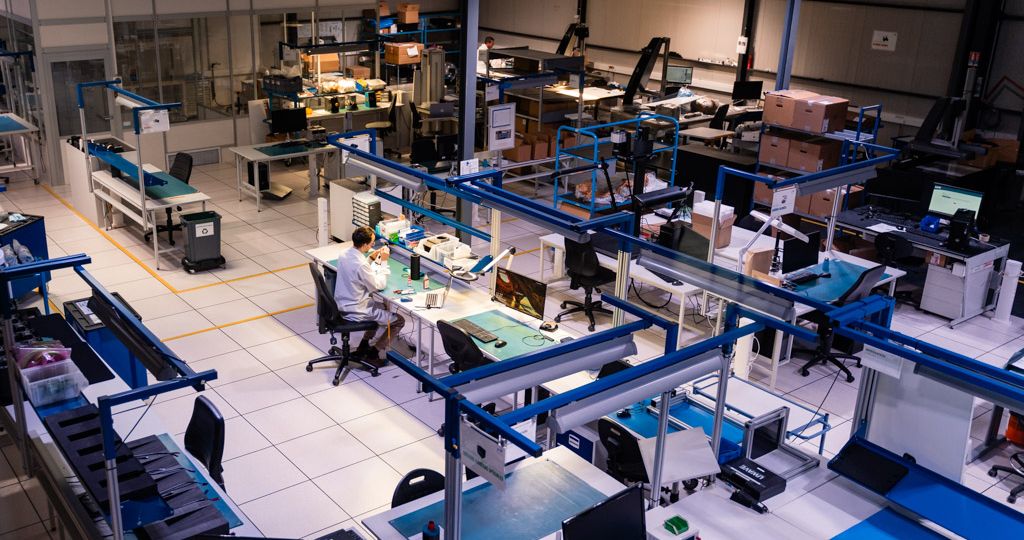
In high-tech industries, a product’s performance does not depend solely on the quality of its design. Innovation alone is not enough. It must be manufactured, tested, replicated, and maintained over time with the same level of rigor as when it was first created.
This is precisely where the industrial tool comes into play—not as a simple production function, but as a strategic pillar capable of transforming innovation into a reliable, durable, and fully controlled solution.
From Design to Manufacturing: An Industrial Continuum
When a company develops complex systems—whether imaging devices, optical equipment, or high-precision electronic systems—every detail matters. The slightest variation in calibration, assembly, or testing can affect overall performance.
An integrated industrial setup creates true continuity between design and manufacturing. Production teams are not separated from design teams. Adjustments are made quickly, communication is direct, and decisions are immediate. Manufacturing becomes a space of expertise, where each operation enriches the technical understanding of the product.
Testing every piece of equipment, mastering critical assembly steps, securing optical and electronic procedures, and validating functional performance—all of this is only possible when manufacturing is conceived as a natural extension of engineering.
This proximity strengthens process robustness and ensures consistent quality over time.
The Demands of High Mix – Low Volume
Many advanced industries now operate under what is known as the High Mix – Low Volume model. Rather than producing millions of identical units, companies manufacture a wide variety of products, often in small or medium batches.
This model creates a constant challenge: remaining flexible without compromising rigor.
An integrated industrial tool must be able to reconfigure workstations, adapt test benches, adjust methodologies, and produce at different times of the year—sometimes in limited quantities—while maintaining the same high standards. Performance no longer comes from economies of scale, but from team expertise, process quality, and organizational intelligence.
This controlled agility becomes a decisive competitive advantage.
Pre-Series: Turning a Prototype into an Industrial Product
Between an R&D-validated prototype and full-scale production lies a phase that is often underestimated yet absolutely critical: the pre-series stage.
This is when theory meets industrial reality. The product is assembled under conditions close to serial production. Operations are timed, analyzed, and optimized. Sensitive points are identified. Assembly and testing sequences are stabilized.
When this phase takes place within the same environment as final production, feedback loops between R&D, industrial engineering, and manufacturing are fast and efficient. Product maturity increases significantly in a short time. Once validated, serial production can begin on solid foundations, supported by robust and proven processes.
Pre-series thus becomes a true accelerator of industrialization.
A Continuous Improvement Loop Through After-Sales Service
An integrated industrial setup does not stop at product delivery. It also encompasses lifecycle management.
When after-sales service is directly connected to production, field feedback does not remain theoretical. It is analyzed alongside the teams who manufacture the product. Root causes are identified more quickly, and technical adjustments can be implemented rapidly.
This organization creates a powerful continuous improvement loop. Each customer return feeds into the evolution of processes and products. Quality improves over time in a structured and measurable way.
A Structuring Choice for Technology Companies
Having an integrated industrial tool represents a significant investment. But in environments where precision, reliability, and durability are essential, this choice becomes strategic.
It secures know-how, protects technological expertise, industrializes innovation efficiently, and guarantees consistent quality—even at modest volumes. Above all, it provides the ability to adapt quickly to market changes and specific customer requirements.
More than a production center, the industrial tool becomes a lever for sustainable performance.
The Example of i2S: Industry at the Core of the Strategy
At i2S, this choice of industrial integration is fully aligned with the company’s vision. The production workshop is not a peripheral entity—it is a central component of the technological model.
By mastering manufacturing, testing, pre-series, and after-sales service within a single environment, i2S secures the quality of its imaging systems and supports its products throughout their entire lifecycle. This organization makes it possible to combine innovation, flexibility, and industrial rigor.
In a sector where reliability and precision are decisive, i2S’s industrial tool is far more than a means of production—it is a true engine of performance and differentiation.