
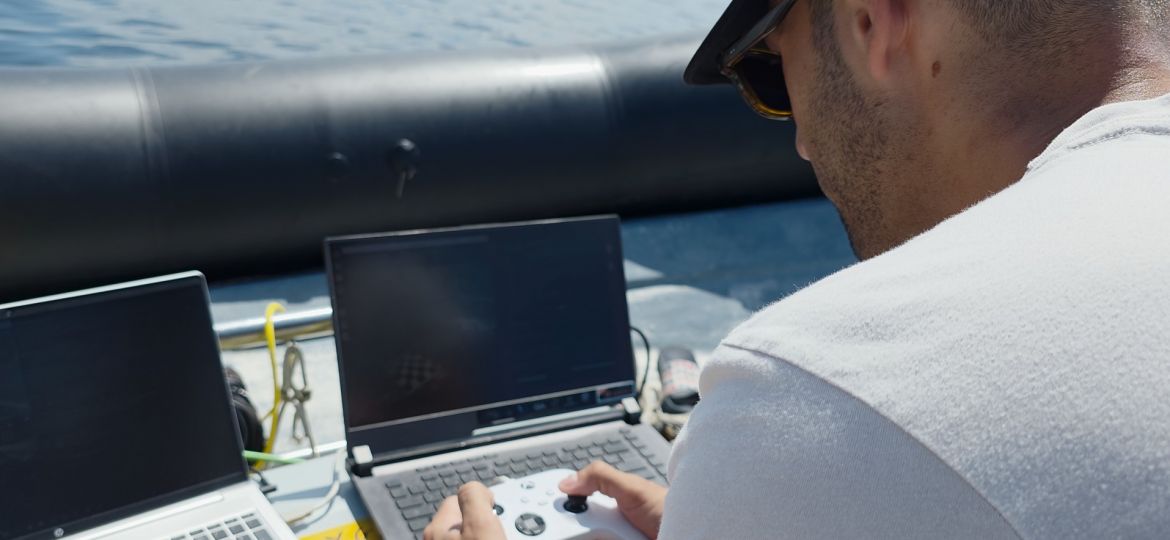
In subsea operations, every mission comes with its own level of complexity. Visibility conditions change, the environment can be unpredictable, inspection objectives vary from one project to another, and operational constraints often require real-time adjustments. In this demanding environment, operators do far more than simply pilot a vehicle or monitor a video feed. They observe, analyze, anticipate, and make decisions that can directly impact safety, inspection quality, and overall mission success.
Imaging naturally plays a central role in this decision-making process. But today, having a high-performance camera is no longer enough. Operators need a software environment that can adapt to their way of working, their equipment, and the specific requirements of each operation. Performance is no longer measured solely by image quality, but by the ability to effectively use and interpret those images in real time.
A MISSION BEGINS LONG BEFORE DEPLOYMENT
Even before a system enters the water, every subsea mission begins with a critical phase: preparation. This is when operators define how they want to conduct their inspection based on the nature of the mission, the type of structure being assessed, the expected site conditions, and the deliverables requested by the client.
Whether the task involves a pipeline inspection, an offshore structure assessment, a maintenance operation, or a scientific survey, requirements can vary significantly. Some operators may prioritize a wide-angle view to maintain overall situational awareness, while others require maximum precision on specific technical areas.
This diversity highlights a simple reality: a single, fixed tool cannot meet every operational scenario. Operators need the ability to build a working environment that matches their mission, their habits, and their priorities.
SEE MORE TO MAKE BETTER DECISIONS: THE VALUE OF MULTI-CAMERA OPERATIONS
Underwater, visual perception is often limited. Light behaves differently, colors fade with depth, and suspended particles can quickly reduce image clarity. In these conditions, every viewing angle matters.
Working with multiple cameras simultaneously fundamentally changes the way operations are conducted. A forward-facing camera may provide an excellent reference for navigation, while a second camera delivers a higher level of detail on a specific area. A third video source can provide peripheral awareness or cover a blind spot, while a fourth may be dedicated to a mission-specific requirement.
This approach allows operators to maintain continuous awareness of their surroundings while performing precise inspections. It improves workflow efficiency, reduces unnecessary vehicle repositioning, and enables faster, more confident decision-making.
The ability to integrate different camera brands and models also provides significant flexibility. Teams can continue using equipment they already know, incorporate specialized sensors when needed, and evolve their setup without being locked into a closed ecosystem.
AN INTERFACE DESIGNED FOR OPERATORS
Whether in a control room or onboard a vessel, operators work in a fast-paced environment. They must monitor multiple video streams, track mission parameters, communicate with teams, and adjust settings without losing focus.
In this context, the interface should never become an obstacle. On the contrary, it should simplify access to information and provide immediate usability.
A modern software environment must allow operators to organize displays according to their preferences, highlight critical information, and modify configurations within seconds whenever conditions require it. Some missions demand increased attention to navigation, while others focus on image quality or detailed component analysis. The interface must adapt naturally to these changing priorities.
The goal is not simply to display more data, but to make that data truly actionable.
INTEGRATED ANALYSIS TOOLS
In underwater imaging, a raw image does not always tell the full story. Environmental conditions can hide important details, alter colors, and significantly reduce contrast. Operators therefore need the ability to adjust imagery in real time without interrupting the mission.
Color correction tools, for example, can restore a more natural representation of observed scenes, improve the visibility of specific surfaces, and reveal details that may otherwise be difficult to detect. A small crack, an area of corrosion, biological growth, or a structural anomaly can sometimes become far more visible after just a few targeted adjustments.
Beyond visual enhancement, customizable overlays provide significant operational value. Displaying depth, heading, date, time, and other system data in real time immediately adds context to captured imagery. Operators can also customize video streams to match mission requirements by adding company branding, project information, or reporting-specific metadata. These details become valuable both during operations and throughout post-mission analysis and reporting.
When these tools are directly accessible within the same environment, operators can remain fully focused on their analysis without switching between multiple software platforms or disrupting their workflow.
A PLATFORM THAT EVOLVES WITH THE MISSION
Subsea operations are constantly evolving, and the tools used to support them must evolve as well. New equipment is introduced, client expectations become more demanding, inspection methods continue to advance, and data requirements grow increasingly complex.
In this environment, high-performance software must be designed to evolve continuously. Compatibility with a wide range of equipment, the ability to integrate new devices, and streamlined access to software updates enable teams to remain operational without disrupting their systems.
Automatic updates play a key role in this process. They allow operators to quickly benefit from the latest improvements, new features, and performance optimizations without interrupting ongoing operations.
The software becomes more than a tool—it becomes a living platform, capable of supporting teams throughout the long-term evolution of their missions.
PUTTING CONTROL BACK IN THE OPERATOR’S HANDS
Ultimately, the success of a subsea mission depends as much on human expertise as it does on the tools available. The greater the flexibility operators have, the better they can adapt their methods to real-world conditions. The more complete their situational awareness, the more powerful their analysis tools, and the more intuitive their interface, the more accurate their decisions become.
This philosophy is precisely what guided the development of the latest version of our underwater camera software: Orpheo.
Designed as an operator-centric, evolution-driven platform, this new version was created to provide greater flexibility, more freedom, and better adaptation to the realities of every mission.
Underwater imaging is moving toward a more open, more flexible, and more user-focused approach. Because in the subsea industry, the best technology is not the one that dictates how people should work.
It is the one that gives operators the freedom to work their own way.