
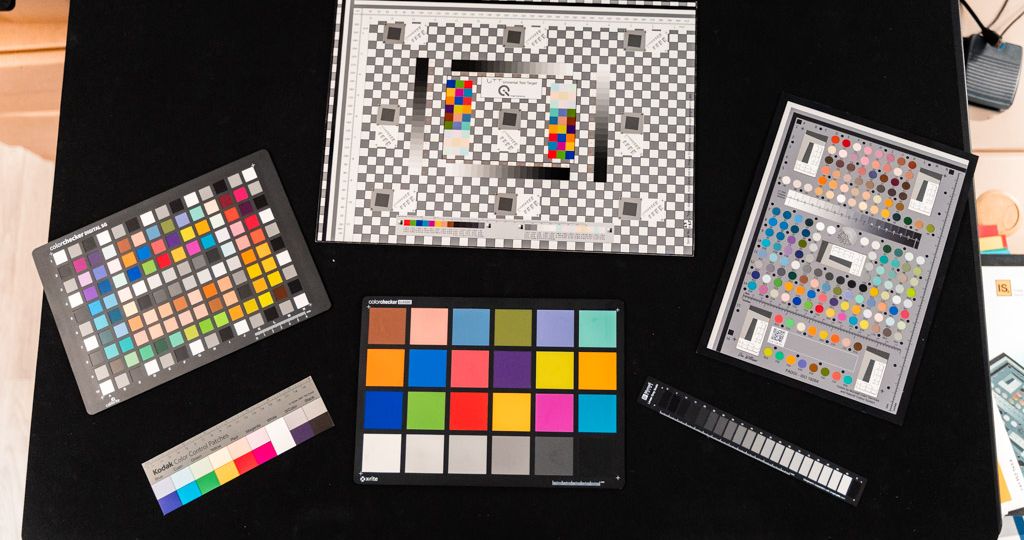
In heritage digitization projects, image quality is a fundamental issue. Libraries, archives, and cultural institutions must be able to rely on image data that is reliable, reproducible, and compliant with international standards such as FADGI, Metamorfoze, or the ISO 19264 standard for image quality evaluation. To meet these growing demands, we recently developed a comprehensive new calibration and quality control module designed to assess the performance of a digitization system according to these international benchmarks. However, this development raises a legitimate question: how can we guarantee the impartiality of a measurement tool when it is developed by the same entity that designs the scanner?
A Question of Trust and Objectivity
In any industrial or scientific field, the principle is simple: the measurement tool must inspire absolute trust. When a manufacturer announces that its own equipment meets the quality criteria defined by international standards, it is natural for users to question the independence of that evaluation. This question is all the more critical in the field of heritage preservation, where digitization campaigns involve substantial investments and create digital resources meant to be preserved for generations. We viewed this question not as a criticism, but as an essential requirement for transparency. In terms of quality control, trust cannot simply be claimed; it must be demonstrated. It is precisely this conviction that guided every stage of our solution’s development.
From Manufacturer to Measurement Tool Publisher: The Need for Independent Validation
Our calibration and quality control module relies on advanced algorithms to analyze numerous criteria: effective resolution, color reproduction, noise, illumination uniformity, geometric distortion, sharpness, and other parameters defined by the FADGI, Metamorfoze, and ISO 19264 standards. These algorithms were developed with a clear ambition: to provide objective and reproducible measurements, regardless of the acquisition system used. However, we believe that an internal claim cannot, on its own, constitute sufficient proof. A manufacturer cannot reasonably be the sole judge of the compliance of its own measurement tools.
Choosing Independent Certification by Bureau Veritas
This is why we chose to submit all our quality control algorithms to an independent validation process conducted by Bureau Veritas. This certification provides an added guarantee: the calculation methods, analysis algorithms, and results produced by our solution have been evaluated by a recognized third-party organization, independent of our scanner manufacturing business. This approach allows us to provide our clients with a clear answer: quality control results do not rely solely on a manufacturer’s declaration, but on an independently verified methodology.
Toward More Transparent and Reliable Heritage Digitization
The evolution of international standards naturally leads stakeholders in heritage digitization to reinforce their requirements regarding traceability, quality control, and measurement reliability. We are convinced that equipment manufacturers have a major role to play in developing increasingly high-performance tools. But this innovation must be matched by an equivalent level of transparency. By having our algorithms certified by an independent organization, we have chosen to place trust, objectivity, and compliance with international standards at the heart of our quality approach. Because in the field of heritage preservation, image quality should never be a matter of trust placed in the manufacturer: it must be demonstrable, measurable, and verifiable.